
What is SEO and How It Works-
Complete Guide
Learn what is SEO means, how it works, and why it matters for Indian businesses.
Introduction: What is SEO?
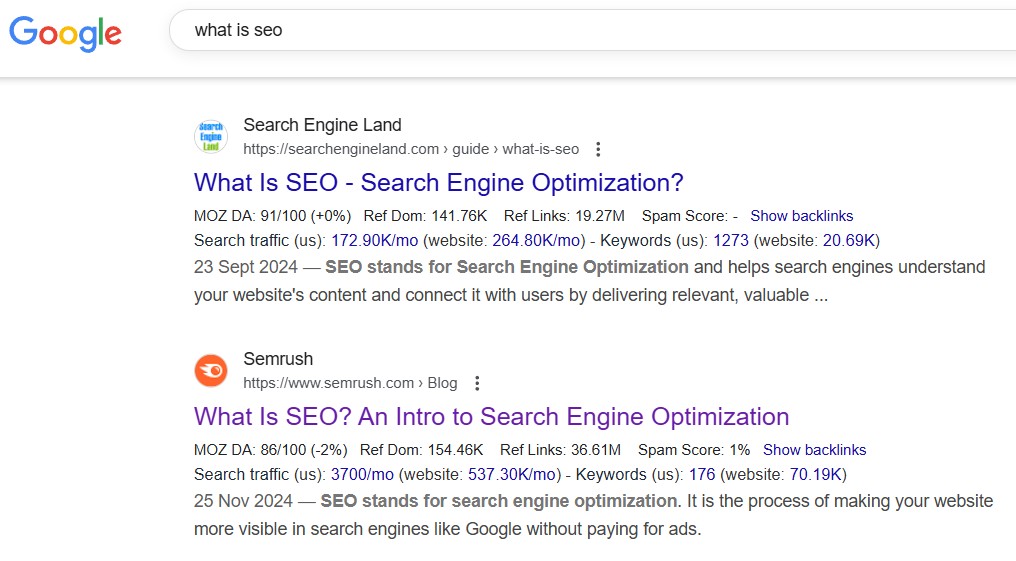
Search Engine Optimization (SEO) is all about enhancing your website so it can climb the ranks on search engines like Google. When folks are on the hunt for products, services, or information, SEO makes sure your content pops up before your competitors.
In India, with a staggering 800 million internet users and a huge surge in searches in local languages, SEO has become an essential tool for businesses, bloggers, and startups alike. Unlike paid ads that vanish once your budget is spent, SEO creates lasting visibility and builds trust over time.
Why is SEO so important?
SEO is essential because it boosts your website’s ranking on search engines. This leads to more organic traffic, enhances visibility, and helps build trust with users.
Establishes credibility: People tend to trust the top results on Google.
Attracts free traffic: You don’t have to pay for every click.
Applicable across all industries: Whether you’re a small shop or a large e-commerce site.
Key Elements of SEO:
On-page SEO: This includes keywords, titles, meta descriptions, and content.
Off-page SEO: Think backlinks, social shares, and brand mentions.
Technical SEO: Focuses on site speed, mobile optimization, and indexing.
Learn more about these SEO types in detail in our complete guide to SEO for 2025.
What is SEO and How It Works
Let’s break down what SEO is and how it actually works. SEO, or Search Engine Optimization, is all about making your website appealing to search engines like Google. These search engines use automated bots, often called crawlers, to scan through web pages, save them in a big index, and then determine their rankings based on over 200 different signals.
Here’s how SEO unfolds in real life:
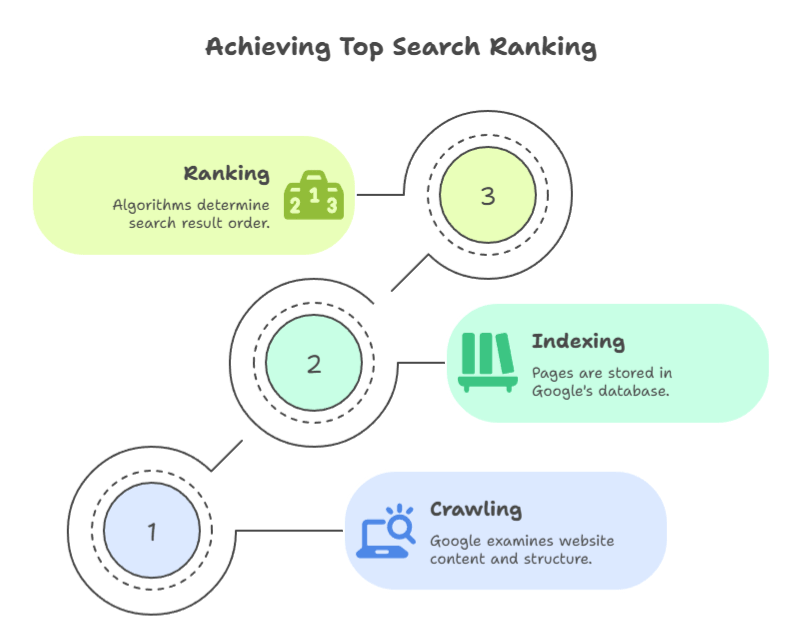
Crawling: Google takes a good look at your website’s text, links, and overall structure.
Indexing: The pages get stored in Google’s searchable database, ready to be found.
Ranking: Algorithms work their magic to decide which pages show up first in search results.
So, how can you help your website rank better?
- Make sure to use the right keywords that match what users are searching for.
- Create high-quality content that genuinely answers people’s questions.
- Build backlinks by getting other reputable sites to link to yours.
- And don’t forget to ensure your site is mobile-friendly and loads quickly.
For example, let’s say there’s a bakery in Delhi. They optimize their website with the keyword “best birthday cakes in Delhi,” add some enticing product images, set up a Google Business profile, and showcase customer reviews. Over time, they find themselves on the first page of search results, attracting new customers without spending a dime on ads.
SEO Meaning for Beginners in India
If you’re diving into the world of small businesses, blogs, or YouTube channels in India, SEO (Search Engine Optimization) is all about making your website easy for Google to find and for people to trust.
It’s the magic behind how your site pops up when someone searches online—without having to shell out cash for ads. Whether you’re running a cozy bakery in Mumbai or sharing fashion tips from Jaipur, SEO is your ticket to attracting free traffic from search engines like Google.
Why SEO Matters for Beginners
Local discovery: It helps your business show up in those “near me” searches (think “best salon near me”).
Cost-effective: You won’t need to spend money on ads every day—SEO is a long-term strategy.
Versatile: It works wonders for blogs, e-commerce sites, YouTube channels, portfolios, and startups.
Trust-building: Climbing the ranks builds credibility with your customers.
Beginner-Friendly SEO Checklist
Task Why It Helps
- Use simple keywords Helps Google grasp your content (like “chai café Delhi”)
- Make your site mobile-friendly Most folks in India browse on their phones—Google loves mobile-friendly sites
- Write helpful content Solves user problems, builds trust, and keeps visitors coming back
- Use free tools Google Search Console & Analytics show you what’s working
- Add your business to Google Google Business Profile enhances your local visibility
- Get reviews Positive ratings boost trust and improve local rankings
📌 Real-Life Example
Imagine a bakery in Mumbai that uses the keyword “fresh cakes Mumbai” on its website and Google Business Profile. When someone nearby searches for “birthday cake near me,” that bakery pops up—without spending a dime on ads.
✅ Final Takeaway
For beginners in India, SEO equals visibility, trust, and growth—all without breaking the bank. It’s the smartest way to establish your online presence and draw in real customers.
SEO vs SEM: A Guide for Indian Businesses
When it comes to getting your business noticed on Google, both SEO (Search Engine Optimization) and SEM (Search Engine Marketing) are key players, but they go about it in different ways.
When to Use SEO vs SEM
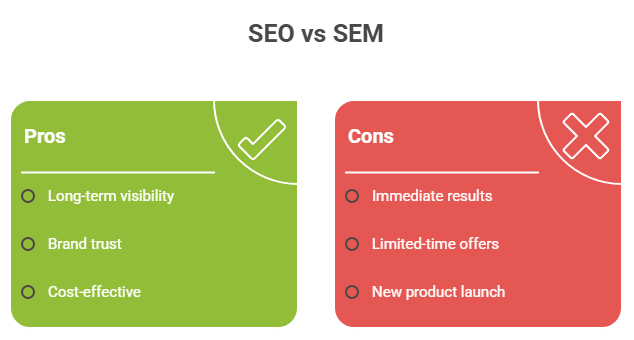
Choose SEO if:
- You’re aiming for long-term visibility without the need for constant ad spending.
- You want to establish brand trust and authority.
- Your budget is tight, but you’re ready to invest some time.
Opt for SEM if:
- You need traffic or leads right away.
- You’re promoting a festival offer or a limited-time sale.
- You’re introducing a new product or service and want to get noticed fast.
Real-World Example
Consider a saree boutique in Chennai looking to expand its online presence.
For sustainable growth, they optimize their website with keywords like “handloom sarees Chennai” (SEO).
During Diwali, they launch Google Ads for “Diwali saree sale Chennai” (SEM) to drive quick sales.
Takeaway
In India, small businesses often find that SEO is the best route for long-term growth. However, pairing it with SEM for short-term promotions can yield the best results—visibility now, credibility later.
How Search Engines Work
Search engines, like Google, are a bit like digital librarians. They sift through, store, and rank information to provide users with the most relevant answers.
Here’s how it works:
Crawling – Google’s bots, often called spiders, go out and discover web pages.
Indexing – These pages are then analyzed and stored in Google’s vast database.
Ranking – Algorithms come into play to determine which page best addresses the user’s query.
What influences ranking?
- Keywords found in content and titles.
- How fast the page loads and whether it’s mobile-friendly.
- Backlinks, which are links from other websites pointing to yours.
- User experience, including bounce rate and time spent on the page.
📊 Example Search:
If someone in Delhi types in “best biryani restaurant,” Google will:
Crawl through all the restaurant websites in Delhi.
Index their menus, reviews, and locations.
Rank them based on relevance, reviews, and proximity.
✅ Takeaway: Grasping how search engines operate can help you optimize your content and boost your ranking naturally.
SEO Glossary of Terms
Navigating the world of SEO can be overwhelming, especially with all the technical terms thrown around. To help you out, here’s a straightforward glossary:
Keyword → The term or phrase that people type into Google when searching (like “digital marketing course Delhi”).
SERP → This stands for Search Engine Results Page, which is basically the page you see after you hit search on Google.
Backlink → A link that comes from another website and points back to yours.
On-page SEO → This involves tweaking titles, headings, and content directly on your site to improve its visibility.
Off-page SEO → This is all about building backlinks, encouraging social shares, and getting your brand mentioned elsewhere.
Technical SEO → Focuses on the behind-the-scenes aspects like site speed, mobile usability, sitemaps, and schema markup.
Organic Traffic → Refers to visitors who find your site through search results rather than through paid ads.
Bounce Rate → The percentage of visitors who leave your site shortly after arriving.
CTR (Click-Through Rate) → The percentage of users who click on your link when it appears in Google search results.
✅ Takeaway: Familiarizing yourself with SEO terminology can really help you grasp the strategies, tools, and reports involved.
Benefits of SEO for Small Business in India
When it comes to small businesses in India, SEO is often the most budget-friendly way to stand up against larger competitors.
Key Benefits:
Affordable marketing – Unlike paid ads, SEO can drive free traffic to your site.
Increased visibility – It helps your business show up on Google Maps and in search results.
Builds credibility – Customers tend to trust organic search results more than advertisements.
More leads and sales – Local searches like “tailor near me” attract customers who are ready to make a purchase.
Long-lasting results – Once your pages are ranked, they keep bringing in traffic over time.
✅ Takeaway: For small businesses in India, SEO means affordable and sustainable growth.
Local SEO Essentials for Indian Businesses
Elevate your local presence with key SEO strategies designed specifically for Indian businesses—make sure to optimize your Google Business Profile, incorporate local keywords, and draw in customers from your area.
Here are some key steps to get started with Local SEO:
- Create and verify your Google Business Profile (GMB).
- Make sure to include your accurate address, phone number, and operating hours.
- Encourage customer reviews, as they can really boost your rankings.
- Use local keywords—think “Best dentist in Bangalore” instead of just “dentist.”
- List your business in local directories like Justdial, Sulekha, and IndiaMART.
📌 For example, a bakery in Chennai that optimizes for “birthday cake shop in Chennai” will pop up when someone searches locally.
How Long Does SEO Take?
A lot of newcomers think they’ll see SEO results right away, but the truth is, SEO is more of a marathon than a sprint.
Here’s a rough timeline:
Month 1–2 → Getting set up (think keyword research and fixing technical issues).
Month 3–4 → Your content starts to rank for some smaller keywords.
Month 6+ → You’ll notice a nice bump in traffic.
12+ months → If you stay consistent, you’ll achieve solid rankings.
Here are some factors that can influence how quickly you see SEO results:
- The age and authority of your website.
- How much competition you have in your niche.
- The quality and frequency of your content.
- The strength of your backlinks.
What is E-E-A-T in SEO?
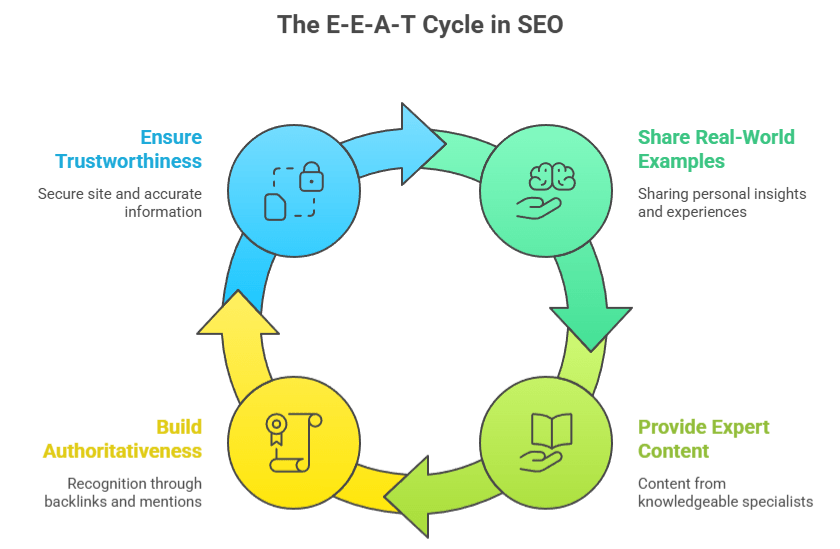
Have you ever heard of E-E-A-T in SEO? It stands for Experience, Expertise, Authoritativeness, and Trustworthiness, and Google rolled it out to help ensure that the content we see is top-notch.
Let’s break it down a bit:
Experience: This is all about sharing real-world examples and personal insights.
Expertise: We’re looking for content that comes from knowledgeable specialists in their fields.
Authoritativeness: This refers to how others recognize you, like through backlinks and mentions.
Trustworthiness: A secure site (think HTTPS) and accurate information are key here.
📌 For example, consider a doctor sharing health tips—that’s high E-E-A-T. On the flip side, a random blogger without any medical background would have low E-E-A-T.
✅ The takeaway? Always make sure to highlight who wrote the content, why they’re credible, and back it up with proof.
Google Search Console Overview
Google Search Console is a fantastic free tool from Google that lets you keep an eye on, manage, and fix your site’s visibility in search results. It provides valuable insights into how your keywords are performing, any indexing problems, mobile usability, and a whole lot more—making it a must-have for boosting your SEO and overall site health.
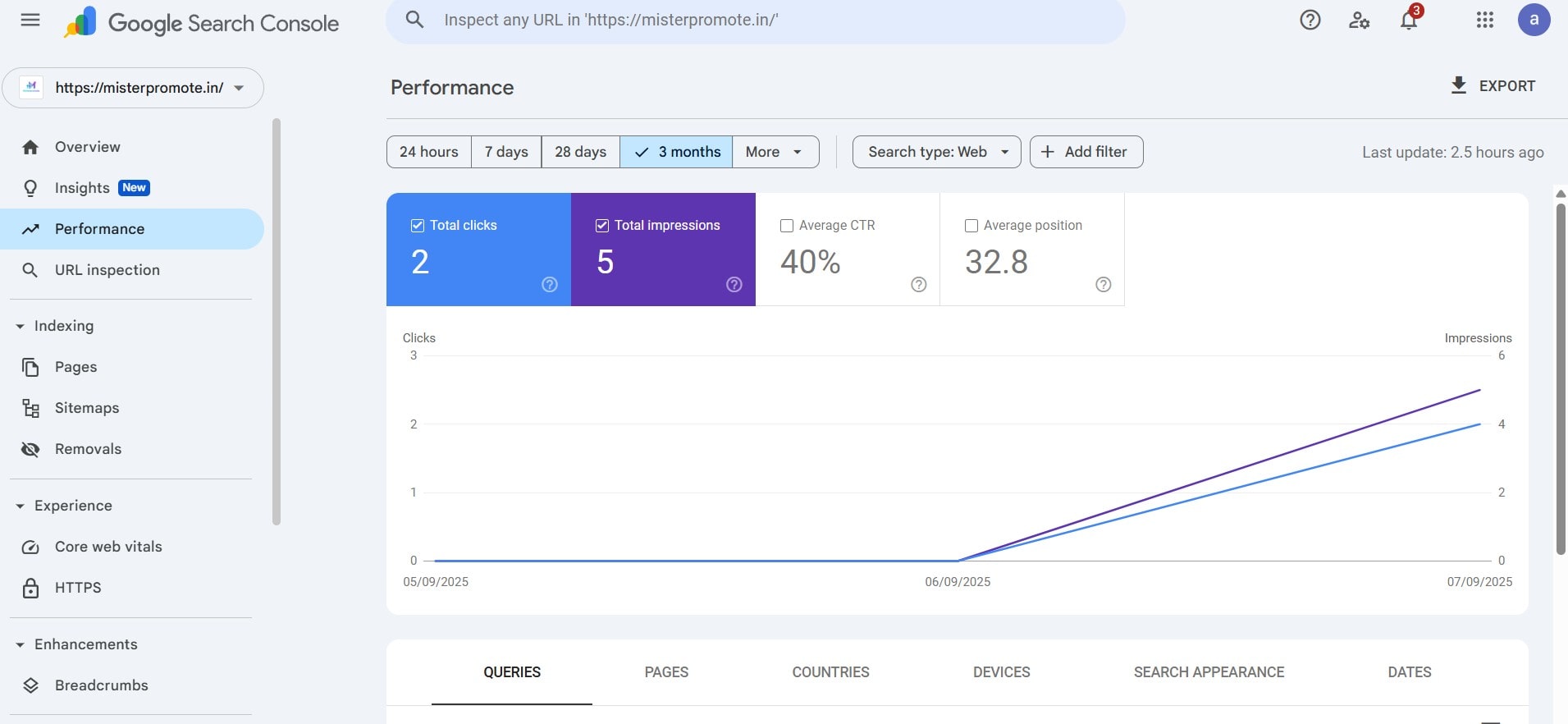
Features:
– Keep an eye on your website’s performance (clicks, impressions, CTR).
– Discover the keywords that are bringing in traffic.
– Check mobile usability and spot any errors.
– Submit sitemaps to speed up indexing.
– Identify and resolve any indexing issues.
Technical Terms:
Impressions – Shows how often your site appears
Clicks– Indicates how many users clicked
CTR – Reflects the effectiveness of titles/meta
Avg. Position – Tells you where you rank in search
Takeaway: Every business and blogger in India should definitely use GSC to track their progress and uncover growth opportunities.
Conclusion
At first glance, SEO can seem a bit daunting, but really, it’s all about making your website friendly for both search engines and users. Unlike paid ads that vanish once your budget runs out, SEO builds a steady stream of visitors, leads, and sales over time.
Key Takeaways:
- SEO = Visibility + Trust + Long-term growth.
- For small businesses in India, SEO is a real game-changer because it’s so cost-effective.
- Local SEO can transform the fortunes of shops, restaurants, and service providers.
- Remember, consistency is key—SEO results don’t happen overnight; they take time.
- Using tools like Google Search Console can help you monitor and enhance your performance.
If you want your business to flourish in 2025, start with the essentials: create valuable content, optimize for the right keywords, and prioritize delivering genuine value to your audience.

Pingback: How Search Engines Work: Mastering Crawling & Ranking